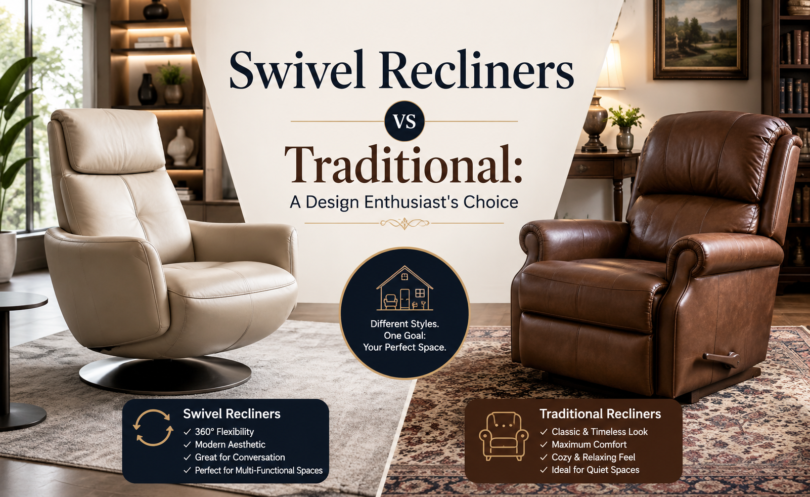

Furniture has become far more than a functional necessity in today’s homes—it’s a statement of personal identity and design philosophy. As living spaces shrink and open-concept layouts dominate modern architecture, every piece must earn its place through both beauty and purpose. Among the most debated choices for design enthusiasts is the recliner: specifically, whether a swivel recliner or a traditional model better serves the dual demands of style and comfort. This isn’t merely a question of preference; it’s a decision that shapes how a room feels, flows, and functions on a daily basis. Design-minded homeowners want furniture that enhances their carefully curated interiors without sacrificing the relaxation they deserve after a long day. They need pieces that integrate effortlessly into existing decor while offering practical, everyday usability. In this comprehensive comparison, we’ll examine how swivel recliners and traditional recliners stack up across aesthetics, ergonomics, versatility, and overall design impact—giving you the insight needed to make a choice that truly reflects your vision for home.
The Evolution of Recliners: From Traditional to Modern Swivel Designs
The recliner’s journey began in the 1920s as a purely utilitarian invention—a bulky, overstuffed chair with a simple lever mechanism that tilted the backrest and extended a footrest. For decades, traditional recliners remained largely unchanged: fixed in position, heavy in appearance, and designed primarily for comfort without regard for aesthetics. These models occupied a single spot in a room, often dominating corners or facing directly toward a television, their placement dictated entirely by their immobility. A traditional recliner, by definition, reclines in place without rotating, limiting both the user’s range of interaction and the chair’s role within a room’s visual composition.
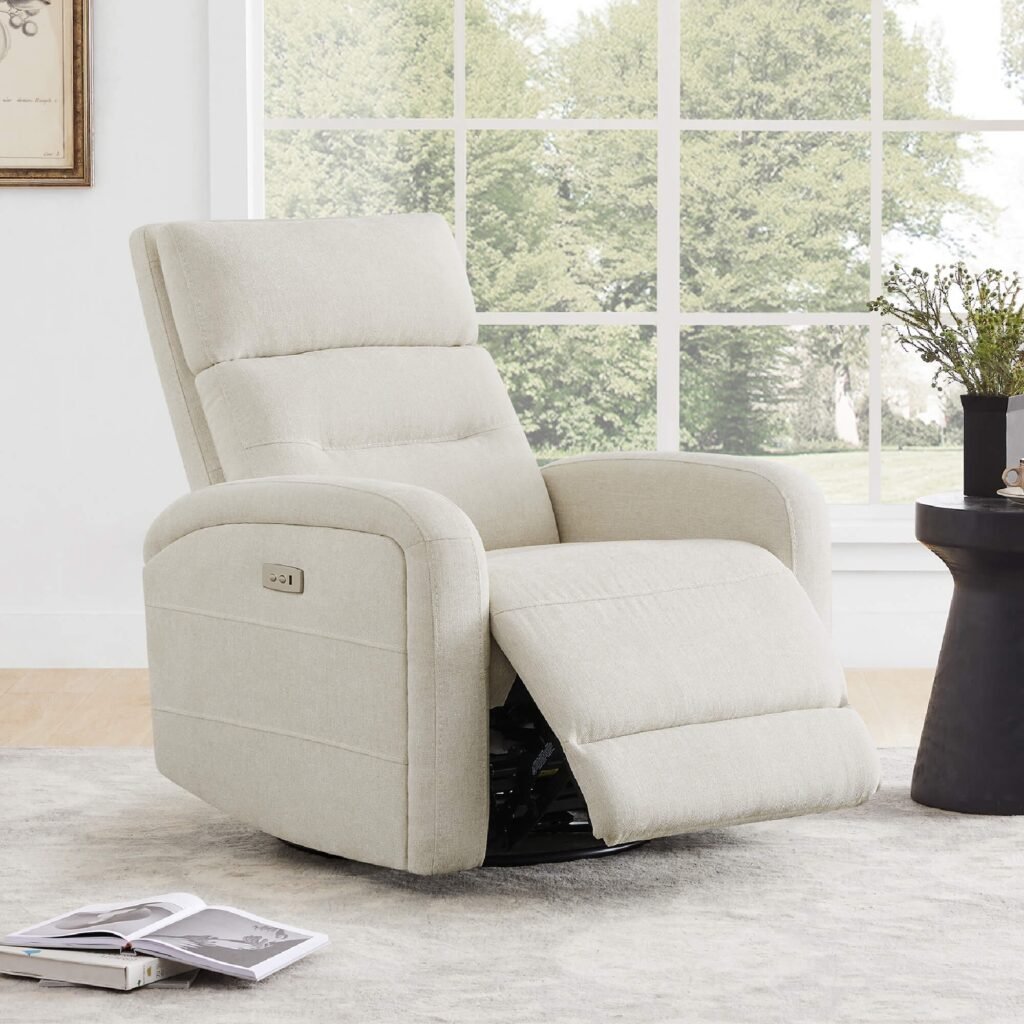
The introduction of swivel recliners marked a fundamental shift in how designers and homeowners think about seating. By incorporating a 360° Swivel Base beneath the reclining mechanism, these chairs transformed from static furniture into dynamic, interactive pieces. The rotation allows users to turn toward conversation partners, pivot between focal points in open-concept rooms, or simply reposition without standing. This evolution matters because contemporary living spaces demand furniture that adapts—rooms serve multiple purposes, layouts flow freely between zones, and rigid, immovable pieces feel increasingly out of step with how we actually live. Swivel recliners represent the convergence of engineering innovation and design sensibility that today’s interiors require.
Design Aesthetics: How Swivel Recliners Elevate Your Space
Integrating Elegant Recliner Styles into Contemporary Decor
What distinguishes an elegant recliner from its clunky predecessors is attention to form—clean lines, tailored upholstery, and proportions that respect a room’s visual balance. Modern swivel recliners come in premium leather, textured bouclé, and performance fabrics in sophisticated palettes ranging from warm neutrals to deep jewel tones. Their silhouettes often draw from mid-century modern aesthetics with tapered profiles, or embrace minimalist sensibilities through low-slung frames and streamlined cushioning. Whether your space channels Scandinavian restraint or eclectic warmth, these chairs integrate as intentional design choices rather than afterthoughts.
The Visual Impact of a 360° Swivel Base
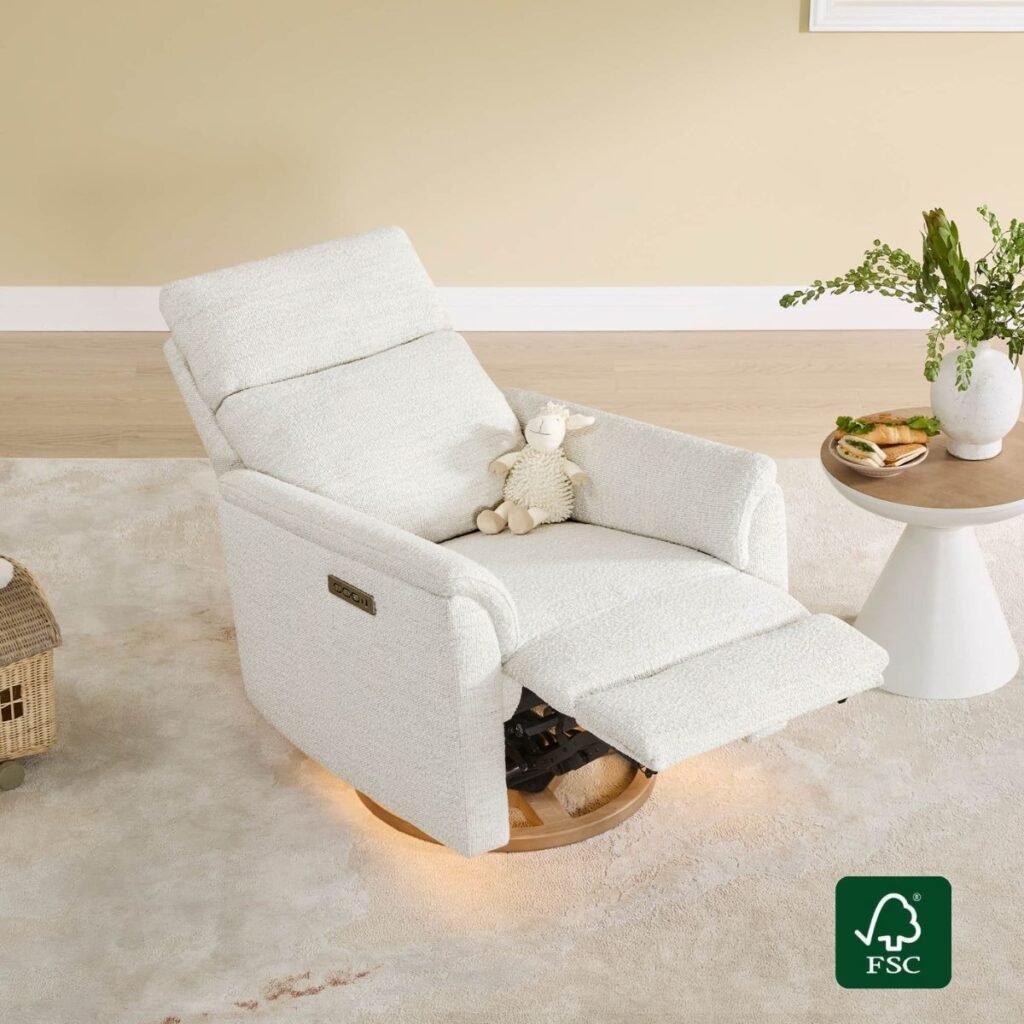
Beyond surface-level style, the 360° Swivel Base fundamentally changes how a recliner interacts with its environment. A traditional recliner locks into one orientation, forcing the entire room arrangement to accommodate its fixed gaze. The swivel mechanism liberates placement possibilities—position it centrally in an open-concept living area, and it becomes a sculptural anchor that engages with multiple zones simultaneously. Guests can rotate toward the kitchen island during conversation, then pivot back toward the fireplace for quiet evenings. This dynamic quality creates visual interest through implied movement; even at rest, a swivel recliner suggests flexibility and intentionality. For design enthusiasts working with compact or multipurpose rooms, this adaptability means the chair never feels like a spatial compromise—it actively optimizes the layout while maintaining its aesthetic contribution to the overall composition.
Functionality Meets Comfort: The Ergonomic Advantage
Understanding Smooth Reclining Action for Daily Use
The Smooth Reclining Action found in modern swivel recliners relies on precision-engineered mechanisms that distribute body weight evenly across the transition from upright to reclined positions. Unlike traditional recliners that often require forceful lever pulls or jarring footrest releases, contemporary swivel models employ tension-adjustable systems that respond to subtle body movements. This means reclining feels gradual and controlled—no sudden jolts or awkward repositioning. For daily use, this refinement matters enormously; a chair you use every evening should never feel like a wrestling match. Traditional mechanisms, while functional, tend to develop stiffness over time and offer fewer intermediate positions, leaving users choosing between fully upright or fully reclined with little nuance between.
Ergonomic Recliner Features for Health and Relaxation
A true Ergonomic Recliner goes beyond simple comfort to actively support spinal health and circulation. Swivel recliners increasingly incorporate contoured lumbar zones that maintain the spine’s natural curvature, padded headrests that reduce neck strain, and multi-position reclining that lets users find their ideal angle for reading, napping, or watching screens. The swivel function itself contributes ergonomically—rather than twisting your torso to reach a side table or speak to someone behind you, the entire chair rotates with you, eliminating repetitive strain on the lower back. Traditional recliners offer reclining comfort but lack this rotational freedom, meaning users compensate with awkward body positioning throughout the day. For those managing back pain or spending extended periods seated, the combination of ergonomic design and 360° mobility in swivel recliners provides measurably better support for modern lifestyles that blend work, entertainment, and rest in a single chair.
Solving Design Enthusiast Needs: A Step-by-Step Guide
Assessing Your Space and Style Requirements
Start by measuring your room’s dimensions and mapping traffic flow patterns—swivel recliners need clearance for rotation, but they actually require less total space than traditional recliners that demand wall clearance behind them for full extension. Consider your room’s primary function: if it serves as both entertainment space and conversation area, a swivel model adapts instantly between uses. Photograph your existing furniture and note dominant materials, leg styles, and color temperatures. This visual inventory reveals whether your space calls for a leather swivel chair with metal accents or a fabric option with wooden details, ensuring your new piece feels native to the environment rather than imposed upon it.
Choosing the Right Swivel Recliner: Key Features to Look For
Prioritize three non-negotiable features during your search. First, test the 360° Swivel Base for silent, fluid rotation—quality bases use ball-bearing systems that won’t squeak or stick after years of use. Second, evaluate the Smooth Reclining Action by cycling through every position; the transition should feel effortless at any stopping point. Third, assess the chair’s silhouette as an elegant recliner by viewing it from all angles, since a swivel chair will be seen from every direction. Beyond these essentials, examine frame construction for hardwood or steel reinforcement, check upholstery durability ratings for homes with children or pets, and confirm that cushion density balances softness with lasting support. Brands like Chitaliving, known for their craftsmanship with wood-framed furniture, demonstrate how quality frame construction contributes to both durability and refined aesthetics in modern recliners.

Practical Solutions for Seamless Integration into Home Decor
Position your swivel recliner as a room’s pivot point—slightly off-center in open layouts creates natural conversational groupings while maintaining visual flow. Coordinate upholstery with secondary elements like throw pillows or curtains rather than matching your sofa exactly; this creates cohesion without monotony. Place a round side table within arm’s reach to complement the chair’s rotational movement, and anchor the arrangement with a circular or organic-shaped rug that echoes the swivel’s geometry. If you prefer the recliner as a subtle addition rather than a focal piece, select a neutral tone one shade darker than your walls and position it adjacent to a bookshelf or reading lamp, letting it serve quietly until someone discovers its full functionality.
Swivel vs Traditional: Making the Informed Decision
When weighing swivel recliners against traditional models, design enthusiasts should frame the decision around three priorities: visual contribution, functional adaptability, and long-term satisfaction. Swivel recliners offer clear advantages in aesthetics—their contemporary silhouettes, refined upholstery options, and sculptural presence make them genuine design assets rather than purely comfort-driven furniture. The 360° Swivel Base delivers unmatched versatility for open-concept homes and multipurpose rooms, while the Smooth Reclining Action ensures daily comfort without mechanical frustration. Traditional recliners, meanwhile, present their own merits: simpler mechanisms mean fewer potential maintenance concerns, their fixed positioning works well in dedicated media rooms where orientation never changes, and entry-level pricing can accommodate tighter budgets.
However, for anyone who values intentional interior design, the calculus tilts decisively toward swivel models. Traditional recliners demand that rooms conform to them; swivel recliners conform to rooms. Consider your decision through this framework: if your space serves a single purpose with a fixed focal point and budget is the primary constraint, a traditional recliner fulfills basic needs adequately. If your home reflects evolving design sensibilities, if you entertain guests, work from your living room, or simply refuse to compromise elegance for comfort, a swivel recliner delivers on every front. The elegant recliner category has matured to a point where choosing style no longer means sacrificing ergonomic support—design enthusiasts can finally have both without apology.
Why Swivel Recliners Are the Future of Stylish, Functional Seating
The comparison between swivel recliners and traditional models ultimately reveals a clear trajectory in furniture design—one that increasingly favors pieces capable of serving multiple roles without visual compromise. Swivel recliners excel precisely where design enthusiasts need them most: they deliver the elegant recliner aesthetics that elevate a room’s composition, the ergonomic support that sustains daily comfort, and the spatial adaptability that open-concept living demands. The 360° Swivel Base and Smooth Reclining Action aren’t merely features—they represent a philosophy of furniture that works with your life rather than constraining it. For those who refuse to treat style and function as opposing forces, swivel recliners prove that thoughtful engineering and beautiful design belong together. As home interiors continue evolving toward flexible, personality-driven spaces, the furniture we choose must evolve alongside them. Prioritize pieces that honor both your body’s need for comfort and your eye’s demand for beauty—your home deserves nothing less than furniture that performs as brilliantly as it looks.