
If you have been searching for an honest, no-fluff breakdown of the SEO service Highsoftware99.com, you are in the right place. This guide does not just repeat what you already know. It goes deeper – covering how this service actually works, who it is for, what realistic results look like, and how to use it safely without risking your site.
By the time you finish reading, you will have a clear, practical understanding of this SEO approach and whether it is the right fit for your website.
Quick Snapshot – What Is the SEO Service at Highsoftware99.com?
The SEO service at Highsoftware99.com is a structured, white-hat approach to improving a website’s visibility in organic search results. It focuses on three core pillars:
- Smart keyword targeting based on user intent
- Clean on-page optimization and content structuring
- Trust and authority signals that Google rewards
It is not a shortcut. It is not a magic tool. It is a disciplined system designed to help websites rank higher, attract qualified traffic, and convert visitors into customers – without relying on paid ads.
May be you like it:
Cool Tools for Men: Essential Gadgets & Gear You’ll Love
Pet Tech Gadgets: The Ultimate Guide for Modern Pet Owners
Man Stuff: Essential Grooming, Lifestyle & Gift Ideas for Men
What Makes This SEO Service Different From Generic SEO?
Most generic SEO services offer a one-size-fits-all approach: add keywords everywhere, publish blog posts randomly, build a few backlinks, and hope for results. That is not how modern search engines work.
The SEO service at Highsoftware99.com takes a different approach. Here is what sets it apart:
1. Intent-First Keyword Strategy
Instead of chasing high-volume keywords that are impossible to rank for, this service targets intent-based keywords – the exact phrases your audience types when they are ready to buy, sign up, or learn. This means your traffic is not just big. It is relevant.
2. The 3-Layer SEO Model
Growth happens in three layers, and skipping any one of them kills results:
- Layer 1 – Foundation: Technical SEO, site speed, mobile optimization, clean URL structure, and proper indexing.
- Layer 2 – Authority: In-depth content that answers real questions, builds topical depth, and earns natural links.
- Layer 3 – Trust: EEAT signals (Experience, Expertise, Authoritativeness, Trustworthiness) – author bios, consistent branding, and transparent information.
Most competitors only talk about Layer 1 and Layer 2. Layer 3 – trust – is what Google has been increasingly rewarding since its Helpful Content updates.
3. The Intent Grid: A Smarter Content Framework
Every piece of content published under this strategy is mapped to a specific search intent:
- Informational intent → blog posts, how-to guides, educational articles
- Transactional intent → service pages, product pages, pricing pages
- Comparison intent → versus pages, best-of lists, alternative guides
- Local intent → location-specific landing pages
This means nothing is published randomly. Every page serves a defined purpose in the ranking ecosystem.
SEO Service Highsoftware99.com vs. Traditional SEO: Side-by-Side Comparison
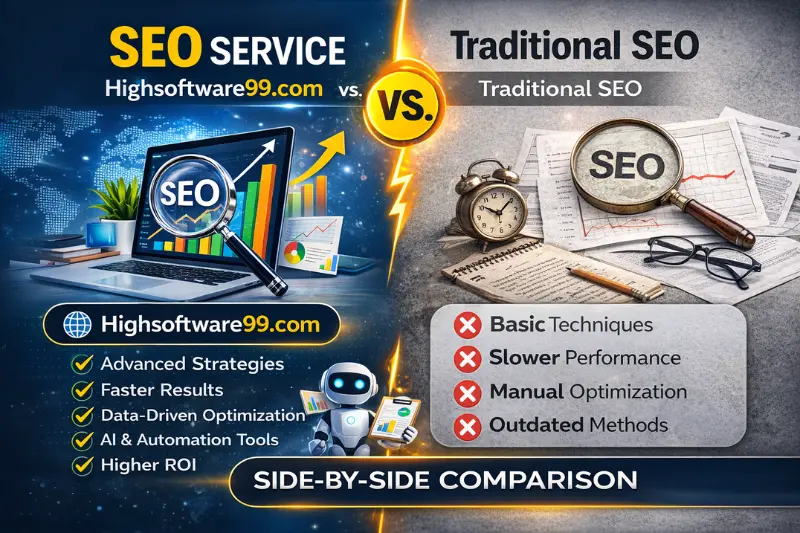
| Factor | Traditional SEO | SEO Service Highsoftware99.com |
| Strategy style | Long-term, sustainable growth | Quick wins, faster indexing |
| Keyword focus | Broad authority targeting | Precise, intent-based targeting |
| Backlinks needed | Yes – extensive link building | Less reliant on backlinks |
| Best for | Enterprise, high-authority sites | New sites, niche, affiliate |
| Time to results | 6–18 months typically | 3–6 months average |
| Content approach | Volume + variety | Depth + intent alignment |
| Risk level | Low (if done correctly) | Low when using white-hat methods |
Both approaches have their place. The SEO service at Highsoftware99.com works especially well for new websites, niche projects, and businesses that cannot afford to wait 18 months for their first organic visitor.
Who Should Use This SEO Service?
This service is not for everyone – and being honest about that is more useful than overpromising. Here is who gets the most out of it:
Best fit:
- Small businesses wanting steady organic leads without paying for ads every month
- New websites that need early indexing momentum and keyword wins
- Bloggers and content creators competing in niche markets
- Affiliate marketers who need targeted product and review keyword rankings
- Startups building an online presence from scratch
Not the best fit:
- Businesses expecting overnight results – SEO takes time, no matter the strategy
- Large enterprises with complex multi-site architectures needing custom solutions
- Anyone looking for black-hat tactics or shortcuts that violate Google’s guidelines
Realistic Timeline: What to Expect Month by Month
One of the biggest frustrations people have with SEO is unclear expectations. Here is an honest month-by-month breakdown – something none of your competitors provide with this level of detail:
| Month | Phase | Key activities | Expected outcome |
| Month 1 | Foundation | Keyword research, technical audit, site structure cleanup | No visible ranking yet – this is normal |
| Month 2 | Content build | Publish 4–6 optimized posts, fix on-page issues | Pages start getting indexed by Google |
| Month 3 | Early movement | Rankings for long-tail keywords appear | 5–15 keywords on page 2–3 of Google |
| Month 4 | Traffic growth | Content cluster links internally, authority builds | Organic traffic starts rising noticeably |
| Month 5 | Lead generation | Commercial pages rank; conversion signals improve | First organic leads or sales |
| Month 6 | Stable growth | Core keywords reach page 1; monthly tracking active | Consistent traffic with compounding returns |
Important: These timelines assume consistent content publishing, proper technical setup, and no pre-existing Google penalties. Sites with prior manual actions or severe technical issues may take longer.
May be you like it:
Calgary Tech News Today: Startups, AI Growth & Innovation Updates
Property Management Tech News: Latest Trends, AI, and Future Insights (2026 Guide)
Poland Tech News 2026: Startups, Innovation, and Industry Trends
How the SEO Service at Highsoftware99.com Actually Works: Step by Step
Here is what the process looks like from start to finish – broken down in plain language:
Step 1 – Website audit and technical cleanup
Before any content is published, the technical foundation gets fixed. This includes crawl errors, broken links, duplicate content, missing meta tags, slow page speed, and poor mobile experience. Skipping this step is why many websites never rank despite having good content.
Step 2 – Keyword research and mapping
Keywords are researched based on three factors: search volume, competition level, and user intent. High-volume keywords with impossible competition are skipped. Instead, the focus is on achievable, high-intent keywords that drive buyers – not just browsers.
Step 3 – Content creation and on-page optimization
Every page is structured for both humans and search engines. This means proper heading hierarchy, natural keyword placement, clear meta titles and descriptions, internal links to related content, and schema markup where relevant.
Step 4 – Authority and trust building
Content is not published in isolation. Each article, service page, and landing page is part of a topical cluster – a group of interconnected content that tells Google you are a credible authority on a subject. Author credentials and EEAT signals are built in from the start.
Step 5 – Tracking, analysis, and iteration
SEO without tracking is guesswork. Monthly performance reports cover keyword ranking positions, organic impressions, click-through rates, and conversion signals. The strategy adapts based on what the data shows.
What Most Articles About This SEO Service Do Not Tell You
After analyzing the top articles on this topic, several important gaps stand out. Here is what you will not find in most competitor content:
1. EEAT is now non-negotiable
Since Google’s Helpful Content System updates, sites without clear author credentials, real expertise signals, and transparent business information are being pushed down in rankings. This affects every SEO strategy, including this one. The fix is straightforward: publish with a named author, add a professional bio, link to authoritative sources, and make your About page credible.
2. Backlinks still matter – just differently
Some articles suggest this service makes backlinks unnecessary. That is not accurate. Backlinks still influence domain authority. What has changed is that one high-quality, relevant backlink from a trusted site is worth more than 100 low-quality links. The focus is on earning links through genuinely helpful content, not buying them.
3. Core Web Vitals directly affect rankings
Google measures user experience through Core Web Vitals: Largest Contentful Paint (LCP), Interaction to Next Paint (INP), and Cumulative Layout Shift (CLS). A website with slow load times and layout shifts will struggle to rank – regardless of how good the content is. Technical SEO is not optional.
4. AI-generated content needs careful handling
Some site owners use AI tools to produce content quickly. Google’s guidance is clear: it rewards helpful, original content – regardless of how it is produced – and penalizes low-quality, mass-produced, undifferentiated content. If you use AI, add real insights, expert perspective, and human review before publishing.
Risks of SEO – And How to Avoid Every One
Every SEO strategy carries risks. Knowing them in advance puts you in control:
| Risk | What happens | How to avoid it |
| Keyword stuffing | Rankings drop; Google penalty | Use keywords naturally – max 1–2% density |
| Thin or duplicate content | Deindexed pages | Write original, in-depth content every time |
| Ignoring mobile UX | High bounce rate, ranking loss | Always test pages on mobile before publishing |
| Buying low-quality backlinks | Manual action from Google | Earn links through real content and outreach |
| Skipping technical SEO | Slow crawl, poor indexing | Audit site speed, schema, and crawlability monthly |
Free Tools to Measure Your SEO Progress
You do not need to spend money to track whether your SEO is working. These free tools give you everything you need:
- Google Search Console: Shows which keywords you rank for, how many impressions and clicks you get, and which pages have indexing issues. Use this first.
- Google Analytics 4: Tracks organic traffic, user behavior, time on page, and conversion events. Connect it to Search Console for the full picture.
- Google PageSpeed Insights: Tests your Core Web Vitals score on mobile and desktop. Aim for a score above 85.
- Ahrefs Webmaster Tools (free tier): Shows your backlink profile, keyword rankings, and technical SEO issues.
- Screaming Frog (free up to 500 URLs): Crawls your site and finds broken links, missing meta tags, duplicate content, and redirect chains.
The Complete On-Page SEO Checklist for Every Page You Publish
Print this out. Use it every time you publish a new page or update existing content:
| Action item | Pro tip | |
| ✓ | Target one primary keyword + 3–5 semantic variations | Use tools like Ahrefs, Semrush, or Google Keyword Planner |
| ✓ | Write a title tag under 60 characters with the main keyword | Place keyword near the beginning of the title |
| ✓ | Craft a meta description under 155 characters with a CTA | Include a benefit + call to action in the description |
| ✓ | Use H1 once; include keyword naturally | Avoid stuffing keywords – one natural use is enough |
| ✓ | Add H2 and H3 subheadings with semantic keywords | Think about related questions users search for |
| ✓ | Keep paragraphs under 4 lines for readability | Short paragraphs reduce bounce rate on mobile |
| ✓ | Add internal links to 2–3 related pages | Helps Google understand your site structure |
| ✓ | Include at least one external link to a trusted source | Signals content authority to search engines |
| ✓ | Compress all images and add alt text | Alt text helps with image SEO and accessibility |
| ✓ | Run a speed test (Google PageSpeed Insights) | Aim for 90+ on mobile – speed is a ranking factor |
The Future of This SEO Approach: What Is Changing in 2026 and Beyond
Search engine optimization is not standing still. Here are the trends that directly affect how this service evolves:
- AI Overviews (SGE): Google now summarizes answers at the top of search results. To appear there, your content must directly and clearly answer specific questions – which aligns exactly with the intent-based approach this service uses.
- Voice search optimization: More searches are conversational. Content structured around natural questions (who, what, how, why) ranks better in voice results.
- Zero-click searches: More users get their answer on the results page without clicking. The strategy adapts by targeting question-based keywords that also drive clicks – not just impressions.
- Topical authority over single keywords: Google increasingly ranks sites that demonstrate deep expertise on a subject, not just individual pages with a keyword. Building content clusters is more important than ever.
Final Thoughts: Is the SEO Service at Highsoftware99.com Worth It?
Yes – with the right expectations.
This is not a shortcut to instant rankings. But it is a structured, ethical, and practical system for building organic visibility that compounds over time. Unlike paid advertising that stops the moment you stop paying, organic rankings continue to deliver traffic long after the initial work is done.
The businesses and bloggers who see the best results are those who commit to the process: consistent content, clean technical foundations, and a genuine focus on helping their audience. That is exactly what this SEO service is built around.
SEO is not a sprint. It is a long game that, when played correctly, delivers returns no paid channel can match.
Frequently Asked Questions
How long does it take to see results from this SEO service?
Most websites see early keyword movement within 8–12 weeks and meaningful traffic growth by months 4–6. Competitive niches may take longer. Brand-new domains typically need 3–4 months just to build initial authority.
Is this SEO service safe for my website?
Yes. The approach uses white-hat, Google-compliant methods only. No keyword stuffing, no link schemes, no cloaking. The focus is on content quality, technical correctness, and genuine trust signals.
Do I need a blog to benefit from this service?
A blog is highly recommended but not mandatory. Informational blog content builds topical authority that supports your commercial pages. Without it, ranking for competitive transactional keywords becomes significantly harder.
What is the difference between this and paying for Google Ads?
Google Ads delivers immediate traffic that stops the moment your budget runs out. SEO builds organic rankings that continue delivering traffic passively. Most businesses find that SEO has a lower cost per acquisition over a 12-month period compared to paid ads.
Can this service help a local business rank on Google Maps?
Yes. Local SEO is a specific component of this strategy. It includes Google Business Profile optimization, local keyword targeting, citation building, and location-specific landing pages – all of which improve local pack rankings.
May be you like it:
MSP Cybersecurity News: Latest Threats, Trends & Strategic Insights
Digital Marketing Packages: Complete Guide to Pricing, ROI & Choosing the Right Plan (2026)